“Look Shivam! Tiger!” screamed Sangeeta in excitement. Shivam jumped impatiently at the prospect of seeing the Royal Bengal Tiger. After all this was the first time in his life that he would see the magnificent animal in the wild. Soon a beautiful Plain Tiger butterfly floated gracefully past fluttering its vibrant orange wings! Shivam’s vexed expression threw us all into splits!
This is the kind of fun, camaraderie and excitement we experience on most trips with Nature India. And this one was no less.
When I decided to join the trip to Panna Tiger
Reserve which included a two hour visit to Khajuraho, it was obvious that I
wouldn’t be able to do justice to such exquisite monuments in such a short span
of time. So, I took off two days prior and spent two full days at the
monuments. My soul couldn’t have been more at peace!
As the great
Scottish naturalist John Muir once said, “Keep close to Nature's heart... and
break clear away, once in a while, climb a mountain or spend a week in the
woods. Wash your spirit clean.”
I was listening….
I will limit this blog to Panna and share the
enchanting Khajuraho experience in another blog.
I was already in Khajuraho when Farhanah,
Sangeeta, Rama and Ashutosh arrived at Jhansi and were received by Mandar.
Shivam and Kalpesh, like me, had arrived two days prior and chosen to spend
time in Jhansi. A delicious breakfast of Aloo
Parathas and Dahi awaited us at hotel
Nirvana. After devouring one wholesome paratha,
Sangeeta innocently asked Farhanah if she would share half a paratha with her. Farhanah’s spontaneous and cheeky
reply was, “Why half?! I’ll have the full one!” The fun had just begun.
We were soon on our way to the magnificent Raneh
Waterfalls fed by the river Karnavati (anglicised as Ken). Formed by a series
of volcanic eruptions a million years ago, the gorge is about 5 kms in length
and about a 100-150 ft deep. This rock formation is a rare case where one gets
to see so many varieties of igneous rocks all at one site. I was mesmerised by
the vivid colour combinations of the rocks which only added to their beauty – the
pink coloured granite, the black basalt, the red jasper, off-white quartz and
the yellow dolomite. While admiring its splendour even in this dry time of the
year, I wondered how stunning it must be during the monsoons!


An hour’s drive south of Raneh is Greetoe Camp
Panna. Nestled amongst trees on the banks of the river Karnavati, this was to
be our home for the next two days. As we cruised slowly towards the Camp,
Shivam pointed out to a canine sitting a few meters away in a grassy patch,
“Dekh! lombdi jaisa kuch hai!” Mandar, Kalpesh and I almost bounced off our
seats. Shivam’s keen eyes had just spotted a beautiful Golden Jackal!
 |
Golden Jackal
|
At the Camp, we were given a warm welcome with a
cool drink of Roohafza. After settling into the comfort of our luxurious tents,
a sumptuous lunch was waiting to be devoured in the main dining hall. After
refusing to share half a paratha, the one with abundant appetite was now
overflowing with generosity and offering half her roti to the rest!!!
With our bellies full, we were off on our first
safari into the jungle. The open jeeps would provide obstruction-less views of
the pristine forest and its inhabitants. We had two jeeps amongst eight of us, which
would take their individual routes once inside the forest.
Panna National Park and Tiger Reserve is tucked
away inside the Vindhyan mountain range in Madhya Pradesh which runs in the
east-west direction and is traditionally considered to divide India between the
north and south. The Vindhyas also provide a link to eastern and western populations
of wild animals. This is also the point where the forest belt, which begins
from Kanyakumari in the south, is broken, and the great Gangetic Plains begin. Panna
is a dry deciduous forest. While natural Teak forests abound in the northern
part of the park, the south is given to mixed varieties like Kardhai, Mahua,
Palash, Ber, Kaththa
etc. and shrubs like Lantana, Ixora, wild Basil, etc. The mystical “ghost tree”
Sterculia Urens is in abundance on the rocky patches of the forest. Striking in
appearance, it inspired awe and wonder in me. It’s pale bark contrasting with
its vibrant red and orange leaves was stark splendour. The ghost tree’s gum is
said to have medicinal properties and is used as a laxative and tablet binder. Interestingly,
natural Teak forests are not found anywhere in India north of this forest
unlike the ghost tree which is found all over the country.
The park has one safari zone which can be
accessed from two gates, Madla and Hinauta. We entered the forest from the
Madla gate. The air had a magical freshness about it. Driving along the dry
paths of the forest, our vehicle kicked up clouds of dust. It was time to pull
up our face covers. A group of langurs jumped blithely from tree to tree. On
seeing our jeep, some mothers cradled their babies protectively. Others ran to
the security of the thickets. Sporadic calls of Plum-headed Parakeets could be
heard in the distance.
The forests of Panna are interspersed with
riverine forests, thorny woodlands and open grasslands with tall grasses like
Needle grass, Kangaroo grass etc. Plum headed parakeets were busy foraging on
the grains and seeds in the tall, thick grasses. The plaintive call of the
Stork-billed Kingfisher resounded in the distance. A little ahead we came to
the first of the many scenic parts of the forest that we were to see during the
next two days. A pristine riverine forest. The reflections of the tall slender trees
standing majestically on small natural islands in the still and clear water
seemed meditative. The serene image will remain etched in my memory forever.
Further ahead on a rocky open patch a couple of Red-wattled Lapwings stood
silent but alert. A lone Grey Wagtail walked amongst them oblivious of our
presence.
 |
| Red Wattled Lapwing |
As we cruised along we saw a flock of Yellow
Footed Green Pigeons perched high up on a bare tree. A Roller sat attentively
on a stump. Suddenly there was excitement as our guide had spotted a Crested
Serpent Eagle. As we stared at it in awe through our binoculars we noticed
another smaller bird of prey sitting close by. At first we weren’t able to
identify it in the low light. It was also at an awkward angle. It was much
later that Adesh identified it as a juvenile Shikra from the record shots that
Kalpesh had taken. I can’t put it in words, but the thrill that these raptors
give us birders is almost scintillating! It’s not as if the other birds don’t
provide such delight, but it’s different with raptors! Only a birder would
understand!
 |
| Crested Serpent Eagle |
 |
| Indian Roller |
 |
| Spotted Dove |
The jungle was mostly quiet as we cruised along.
Our driver scanned the ground beneath for pug marks. Suddenly the shrill alarm call
of a peacock broke the silence. Already having an ear open for alarm calls, our
driver was quick to locate the direction from which the call was coming and
started driving in that direction. We would make an attempt at a tiger
sighting. Earlier in the day, a tigress P151 was seen with her 3 cubs near one
of the water bodies nearby. She would definitely return to the same spot
sometime later in the day. We decided to wait in that area and try our luck. As
we raced towards the spot my heart began pounding with excitement.
The presence of a tiger in the vicinity is often
announced by Langurs from tree tops using a barking sound. This is further
relayed by high-pitched, short and intense sounds made by other animals like Spotted
deer and Sambar deer. Even peacocks join the chorus. However, these alarms are not necessarily for
the tiger. They could also be for other smaller predators like wild dogs or hyenas
or even a leopard. But what is interesting to note is that it is the Sambar
deer’s alarm call which is a sure-shot indication that it is indeed a tiger on
the prowl. The smaller predators do not pose any threat to the enormous sambar
deer so it sends out an alarm only when it senses a tiger in the area!
We waited for a few minutes at the spot with hope
in our hearts. This time the tigress was to elude us. She must have sensed our
presence and taken a different route.
 |
| Bay-backed Shrike |
Along the way our guide pointed to a shrike
sitting on bare, dry branches. It was unmistakeably a Bay backed Shrike with its
reddish-brown back. Just a few minutes later we came across a Common Stone Chat
perched on the very tip of a tall blade of grass.
As we drove along the open grasslands, we could
see the sun setting beyond the distant mountains. A wild boar gave us a
quizzical look as he nibbled on some grains. A peacock pranced about daintily
in the tall grasses pecking at seeds. We noticed he was without his gorgeous
tail which is his breeding plumage. Ever wondered why, amongst avian species,
it is the males who are brighter and more colourful than the females? This is
because the males have to compete with others for the
chance to mate with females. Some male birds grow colourful plumage in
their breeding season. The females of their species, in contrast, are dull and
drab because in most cases it is the female who sits on the nest during
incubation. At this time, they are vulnerable to attacks from predators so they
have to blend in with the surrounding environment. This peacock would grow his
breeding plumage just before the onset of the monsoons and begin his
resplendent dance to attract his lady love.
 |
|
As the sun was setting, it was time for us to
leave the reserve. Tiger reserves in India follow strict timings and rules and
all vehicles must be out of the reserve at the designated time.
Back at the Camp, we were greeted with a glass of
luke warm water and some jaggery. Jaggery is considered to be a remedy for
respiratory disorders and throat problems. It relieves irritation in the throat
and eases the accompanying throat pain. So, after a ride in the dry and dusty
forests, this wonderful gesture from the resort staff was truly heart-warming.
Dinner wasn’t without its usual fun and
camaraderie. Continuing with her refrain of ‘half’, Farhanah was now asking
Rama to share half a bowl of curd! But curd was the last thing Rama would share
with anyone! Her husband Ashutosh could vouch for that! She could have her curd and eat it too!!!!
After dinner, as per the usual practice in all
Nature India camps, we had a quick re-cap of the day’s sightings after which we
called it a day.
I woke up to the sublime tune of “ik omkar” my alarm ringtone at 4.30 the
next morning. We were to leave the resort by 5.30 to be on time to enter the
reserve at the designated time of 6 am. So off we were in our open jeeps
excited like school children and looking forward to some great sightings. There
was a nip in the air. We were well prepared for the cold with all our woollens.
At the gate, as we waited our turn, Sangeeta pointed at some Plain Tiger and
Blue Tiger butterflies that fluttered around gracefully. Shivam, who was not
familiar with butterfly names sprang to his feet on hearing the word tiger! It
was one of the many fun moments that we all shared, pulling each other’s legs
and having a hearty laugh!
The Karnavati River flows through the Panna Tiger
Reserve for about 55km. This perennial river is considered to be the lifeline
of the forest and is one of the least polluted rivers of India. The terrain of Panna has “table-top”
topography which is broadly divided into two plateaus, upper Talgaon plateau,
middle Hinnauta plateau, and the Ken valley. There are series of undulating
hills and plateaus rising on the other side of the river as far as the eye can
see! A tiger country, the reserve is also home to a large variety of fauna,
including leopard, wild dog, sloth bear, spotted and sambar deer, chinkara, nilgai,
wild boar, langur, mongoose, palm civet, etc. There are more than 200 birds,
including seven of the nine species of vultures found in India. Muggers and
gharials are found in the Karnavati River.
Panna is by far one of the most picturesque
forests of central India.
The day was just about breaking. The mist was
still hanging low on the distant grasses. It was calm and serene. We could hear
a faint ‘pook-pook-pook-pook’ of the Coppersmith Barbet and a sporadic ‘tui’ of
the Plum Headed Parakeet. A Nilgai grazed amongst the ber groves as we
sauntered quietly by. Langurs hung around amongst the dry kardhai trees.
A Roller was perched on a stump undisturbed by our presence. Suddenly the calm
of the morning was broken by a sudden burst of excitement. We had sighted a
raptor! A White-eyed Buzzard sat majestically on a stump of the dry tree. Like
the Roller, he too didn’t seem to be perturbed by our presence and we watched him
to our hearts’ content.
 |
| White-eyed Buzzard |
As we waited in the grassland alongside another
jeep which was also doing the rounds, listening for any alarm calls, our guide Sakshi
got news that the resident tiger P243 had been sighted near Dhundhwa Seha. It
was the second burst of excitement within minutes! But this time it was not
just excitement. It was almost like a frenzy. No sooner had Sakshi announced
the news than our driver hit the accelerator and off we were in pursuit of the
majestic animal. Tigers have always fascinated us with their regal and elusive
presence. As we sped through the forest through clouds of dust, I could hear my
heart pounding at the prospect of seeing a tiger. It was a long and bumpy ride
which seemed endless. But eventually when we reached the spot, I felt an
overwhelming sense of exhilaration. The huge and majestic animal gave us a
‘road show’ in tiger safari parlance. We noticed a wound on his forehead as he
strode head-on towards us, calmly along the path barely 10-15 meters away from
us. I was mesmerised. Shaking myself out of my stupor as I readied my camera to
take as many pictures as I could in that window of a few seconds that we had, I
saw Shivam posing for a selfie with the tiger in the background!! I struggled
to steady my hands at the hilarious sight! As P243 walked towards us, we had to
periodically move our vehicle back to give him his right of way. We did this a
couple of times and eventually after walking in the open for a few meters, he
left the path and disappeared into the forest. Those few minutes seemed like
eternity. Every second of this vivid
experience will remain etched in my memory forever.

And this memory will also remain special because P243
is a special tiger. He holds the distinction of being one of the rare tigers of
India when he was found to have been taking care of his four cubs after the sad
demise of their mother. In the wild it is usually the tigress who looks after
the cubs till they are about 15-24 months old. A tigress usually chooses a cave
or thick bushes to deliver her cubs. The new born cubs are completely blind and
helpless. Until they can start seeing, they remain in the security of the den.
The tigress is devoted to their needs and will protect them fiercely from
predators or intruders. She will help them suckle on her and spend a lot of
time keeping them warm by licking them. After they are old enough to eat, she
will hunt for them, feed them and as they grow older will begin teaching them
hunting and survival skills before they separate to establish their own
territories at about two years of age. So, when the mother of his cubs
succumbed to some injuries when they were just 8 months old, P243 did something
extraordinary. He began providing them with food. Two days after
the death of the tigress, the forest search team had located the cubs with the
help of camera traps. All the cubs looked healthy, active and seemed neither
hungry nor stressed. This was strange. They wondered where the cubs were
getting their food from. They probed further. After keeping an eye on their
movements, they found out that it was their father, P243, who was providing
them with food! He would make a kill and leave the prey in their territory.
They observed many such incidents during the course of the next few
months. P243 was never seen again with
any other tigress. It is reported that he also visited the cremation site of his
tigress and the mother of his cubs within an hour of her cremation. The next
day, he was found sitting for long hours at the place where she had died. Incredible
indeed!
Our craving to see the tiger having been
satiated, it was now time to satiate the hunger in our bellies! We proceeded to
nearby Dhundwa Seha gorge popularly called Vulture Point which was also our
breakfast point. Delicious cheese sandwiches, boiled eggs and a hot cuppa chai
were devoured in no time.
Panna is home to seven of the nine vulture
species found in India. This gorge provides excellent habitat for vultures to
nest and also roost. There were about 7-8 Long-billed Vultures nesting on the
rocky edges of the gorge. The sight of the enormous scavengers spreading out
their wings to take in the morning sun was awe-inspiring. A lone Shaheen Falcon
shared the spot with the vultures. Once numbering a few million, the numbers of
vultures in India saw a catastrophic fall between 1990 and 2007. Experts had
zeroed in on diclofenac, a veterinary drug used for pain management in
livestock, as the main cause of the near wipe-out of vultures alongwith other
causes like habitat loss. In view of this threat to vultures that brought them
close to extinction, diclofenac was banned for veterinary use in India. Despite
this ban, cattle carcasses in India continue to be found containing potentially
lethal concentrations of diclofenac. Even today vultures continue to face
the threat of extinction and fall under the ‘Critically Endangered’ category in
the IUCN Red List of Threatened Species.


An interesting fact about the feeding habits of
vultures was explained by Mandar during one of our post-dinner sessions. When
feeding, vultures maintain a strict social order based on the size of their
body and strength of their beak. As they are scavengers they feed mainly on
carcasses of dead animals. They can be categorised into four feeding groups.
The first is the king vulture, second, all the long-necked vultures which
include most of the vulture species like White-rumped, Indian, Cinerous, etc.,
thirdly smaller vultures like Egyptian vultures and lastly the lammergeiers or
bearded vultures. When a carcass is detected the long-necked vultures will gather
around it in huge numbers. But however hungry they may be, they are unable to
start digging into their meal. The reason? Their beaks are not sharp enough to
cut into the thick and tough skin of the carcass. So, they have to patiently
wait for someone else to do that for them. And who else but the King to do the
honours! The King vulture or Red-headed Vulture has a beak capable of ripping
apart the toughest of skin, tendons and muscle. As the King arrives the others
make way for him. He struts around asserting his royalty and then makes a
bee-line for the softer outer body parts like eyes and testicles. After all he
knows pretty well that once the carrion is open, he would have little chance to
have his fill amongst the other long-necked scavengers who simply outnumber
him. The number of King vultures is usually a fraction of all the other long-necked
vultures. So, our ‘Jack the Ripper’ will now rip open the carcass and hurry to
get whatever he can lay his hands on! He will then beat a hasty retreat before
the long-necked vultures, who were till now waiting around, rush to thrust
their long bare necks into the slit made by him and devour the entire carcass. The
‘gulpers’ should we call them? Their long bare necks allow them to reach deep
into the carcass. Smaller vultures like Egyptian vultures must wait for the small
scraps left behind by the larger, dominant species. These ‘scrappers’ will now
polish off the leftovers. Now what
remains are the bones of the carcass. The Lammergeier or the Bearded vulture
now comes into the picture. Lammergeiers inhabit the mountains of northern
India and unlike other vultures, they don’t have a bald head or bare neck. The
bones which remain after the carcass are devoured by other vultures are picked
up by Lammergeiers which drop the bones from heights as great as 80-100 metres
onto flat rocks below. These ‘chuckers’ thereby obtain access to
the marrow of the bones that have broken and polish off the bones
with it. Absolutely nothing goes to waste in the natural world. Scavengers like
vultures play an important role in the eco-system. Carcasses contain bacteria
and other pathogens, which, if left to thrive, may spread within the local environment and
infect other animals, including livestock and humans. By feeding
on carcasses, vultures eliminate these harmful substances from
the environment, thereby mitigating the spread of disease that may
otherwise impact the food chain. And the cycle of life and death continues.
The sun was now high above and the temperature
was slowly rising. It was time to shed some layers of our warm clothes. A
Crested Serpent Eagle sitting on a bare branch created a stir amongst us as
does every raptor. It made a pretty picture. Kalpesh and I were soon aiming and
shooting. Mandar now calls us ‘sharp shooters’! In a span of 45 minutes we saw
yet another Crested Serpent Eagle.
 |
| Yellow-footed Green Pigeon |
A flock of Yellow Footed Green Pigeons
basked on a tall, bare tree. A vivid flash of colour glided across our path and
disappeared into the tall grass in the blink of an eye. It was the elusive Painted Francolin. We could
hear the cooing of the Turtle Dove in the distance.
It was time to return to the gate. A herd of Spotted
deer rested in the shade of palash
trees. Peafowl strutted around gracefully near a water body. The inhabitants of
the forest were winding down for the afternoon when the sun would be at its
zenith.
Back at the resort we were greeted with the usual
jaggery and warm water. Sangeeta pointed out some butterflies – Common Rose,
Common Mormon, Emigrants, Pansies, etc. within the campus of the resort.
A wonderful thing about going on nature trips
with Nature India is that all participants are treated as family. We eat
together, have conversations, poke fun at each other…. There is a lot of
camaraderie amongst participants. Also, the post lunch and dinner discussions
are very informative as Adesh and Mandar share amazing facts, stories and their
experiences.

Our afternoon safari
began with the sighting of a raptor soaring high above just before we entered
the reserve. It was the Bonelli’s Eagle. Sangeeta as usual was busy showing
Shivam some butterflies. This time it was not just Tigers! There were a couple
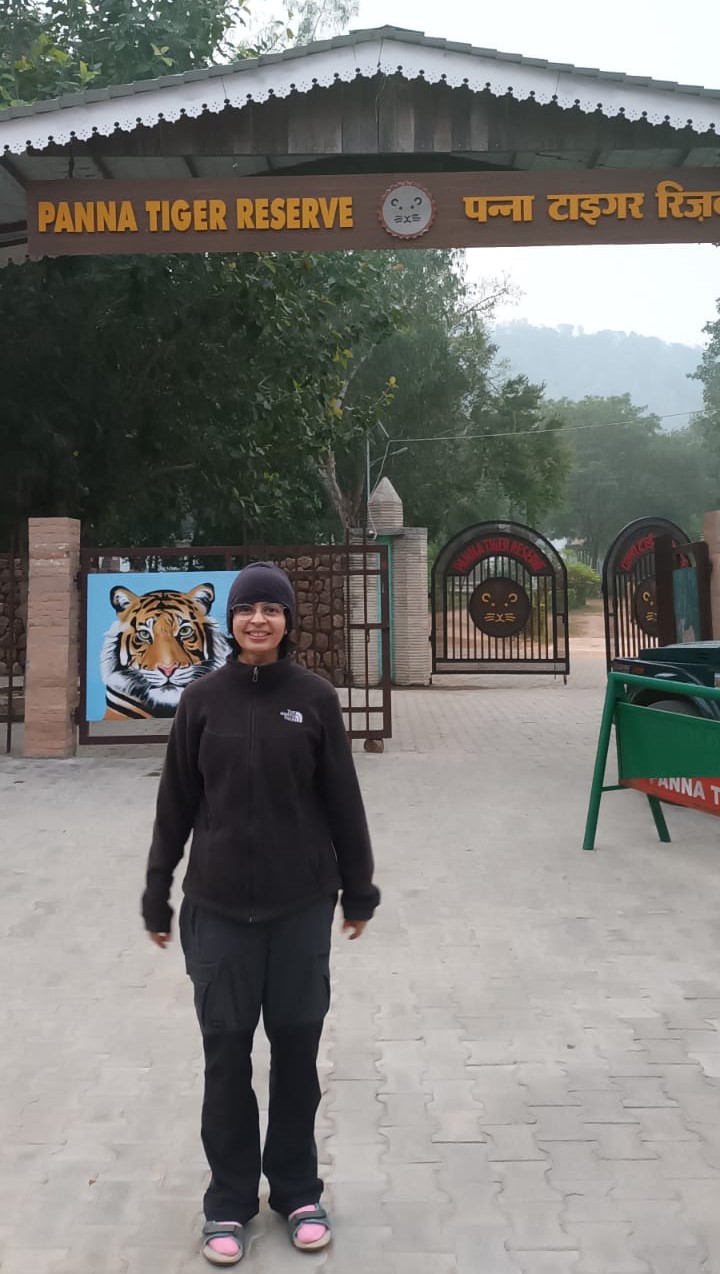
of Sailors and Common Mormon. Farhanah posed in front of the gate as she had her
picture taken while Rama and Ashutosh waited in the jeep. At the very end of
the trip, when I asked if any of us had a picture of the main gate of the
National Park, Farhanah promptly sent me one with herself in the picture,
saying, “here it is but you’ll have to deal with me in it!” It was then that the wicked half of someone came
to the fore who suggested we could do away with the lower half which had her in
the picture!!
The rays of the afternoon sun filtered through
the canopy of the jungle. As we drove along the dusty path some spotted deer
grazing in the tall grasses, couldn’t care less about our presence. We soon
came to the meditative spot near the water body with reflections of the tall
slender trees. As I stood up to take some pictures on my cell phone, Mandar
noticed a baby Marsh crocodile sitting still on a fallen log. Panna is home to
two of the three crocodile species found in India. ‘Mugger’ or Marsh crocodiles
and Gharials. While the Marsh crocodile is classified as ‘vulnerable’, the
Gharial is ‘critically endangered’ on the IUCN Red List of Threatened Species and
the Saltwater Crocodile found in the eastern part of India, is of least concern
on the Red List.

The road along the Karnavati river was uneven and
bumpy. Layers of slate were visible on the road sides. Flocks of Egrets, a Grey
Heron and a Woolly Necked Stork basked on top of the shrubs close to the water.
A Grey Bushchat female took its usual perch atop a teak tree. The landscape with tall
green and brown grasses with their white inflorescence looked picture perfect.
Following some alarm calls, we once again made an attempt for a sighting of the
tigress P151 with her cubs. But there wasn’t enough time on hand as it was time
to return to the gate. She remained elusive for the second time. On our way
out, a flock of Grey Francolins, were busy feeding on some seeds. They scurried
into the tall grasses on seeing us. It was end of yet another satisfying day in
the forest.
 |
Grey Bushchat female
|
Waking up early in the morning to the tune of ‘ik
omkar’ feels subliminal. After a hot and refreshing cup of tea we were off
on our last safari in the park which I was so looking forward to. Would I be
lucky enough to see another one of Panna’s famous tigers today? I took a deep
breath of the cool fresh morning air as we entered the forest. A Nilgai family
hurried across our path on seeing us. The sun was just about rising and mist
hung in the air. A Tree Pipit sat on the edge of a dry branch fluffing its
feathers to keep itself warm. Our driver stopped the jeep and switched off the
ignition to listen to the sounds of the jungle. It was music to my ears. As we
waited, another jeep which was doing the rounds stopped close by. I recognised
our guide Sakshi from the previous safari. She was beaming on seeing us! After
all she was the one with whom we had shared the exhilarating experience of the
sighting of P243 the previous day. As we indulged in small talk with her, she was
interrupted by a call on her mobile. The caller had called to say that Kanhaiya,
another male tiger, had been sighted in the Bhudhrondh area! The news set our
hearts pounding once again. We lost no time in speeding away through clouds of
dust, hanging onto the bars of the jeep for dear life. The drive seemed
never-ending. From a distance we could see several jeeps lined up along a path.
Kanhaiya had just given them a glimpse of his majestic self. We were just on
time to see his imposing figure as he ambled across the path, scent-marked his
territory and entered the thickets. My eyes followed him as he made his way
through the foliage until I could see him no more. I couldn’t but think of William
Blake’s famous poem ‘The Tyger’. Such a vivid expression of marvel and wonder
at the tiger and its fearsome power!
Tyger Tyger, burning bright,
In the forests of the night;
What immortal hand or eye,
Could frame thy fearful symmetry?

Panna Tiger Reserve has an amazing story of tiger revival. In 2009, there were no tigers left in Panna Tiger Reserve. They were all victims of poaching. What happened in the next 10 years was really heart-warming at a time when the world's tiger population was under a serious threat. The administration introduced the Tiger Reintroduction Project. Amongst other things, they studied the socio-cultural demographics of the Panna region. Pardhi tribes, known to consider hunting as a parameter of valour and prowess, inhabit the outskirts of Panna National Park. Before the imposition of a strict vigilance in Panna to check tiger poaching, the Pardhis often engaged in hunting the tiger and it is said that they also engaged in the illegal trade of its body parts. But, the main reason behind the extinction of tigers in Panna was not only the Pardhis. There were others engaged in the mindless poaching. These poachers were trained to hunt discreetly at night, evading the forest guards. The poachers brutally hunted down every last tiger in Panna, until no tiger lived in the National Park.
When the Tiger Reintroduction
Programme was tabled, it involved a two-pronged approach. While the forest
department, under IFS officer R Sreenivasa Murthy’s supervision, focussed on
repopulating the tiger reserve, the non-profit organisation, Last Wilderness
Foundation, was roped in to relocate the local Pardhi tribes and make them give
up hunting. Amidst a series of failures and obstacles, their efforts have
resulted in 54 tigers including adult males, females and cubs calling the Panna
their home. Amongst the obstacles was one interesting incident of a tiger named
T3, who kept returning to his ‘home’ in Pench. T3 was relocated from Pench to
Panna as part of the rehabilitation program. But he infamously strayed off
after ten days and was found moving in the direction of Pench. It needed an
entire army of 70 forest guards with four elephants to track him down. They
even collected several litres of female tiger urine from zoos and spread it
around the forests with the hope that T3 would be lured by the presence of a
tigress. Interestingly, officials believe that perhaps, the tiger wanted to go
‘home’ to Pench, his original habitat. The incident was one of the rare
instances in zoological history where a tiger displayed signs of ‘homing
instinct’.
I had a smile on my face and gratitude in my heart. For “Deep inside the
forest I stroll, to hear the wisdom of my soul.”
 |
| Golden Oriole female |
A White-eyed Buzzard, some Yellow Footed Green Pigeons and a female Golden
Oriole gave us glimpses of their beauteous selves. As we approached the Vulture
Point, Kalpesh thought out aloud, “now all we need is one king vulture
sighting”. Lo and behold! Our guide pointed out to a Red Headed ‘King’ Vulture perched
high up on a distant tree! The great writer Paulo Coelho had so rightly said,
“when you really want something, the entire universe conspires in helping you
achieve it”! Although the stately bird was too far and against the sun for a
good picture, the universe had heard our prayer! We took a few record shots and
proceeded to Vulture Point for breakfast. Ohh to relish delicious aloo
parathas with pickle and piping hot tea deep in the jungle amidst nature’s
music! Gratifying to say the least! It was now selfie time for Shivam! And
Kalpesh was his partner in crime! The marvellous backdrop of Dhundhwa Seha
provided them a lovely photo-op.
It was time to head back to the gate. A Hoopoe pecking at seeds fallen on
the ground took to his wings on seeing us. A herd of spotted deer lazed in the
shade of the ber trees, chewing on
grass and leaves. Most of them handsome male deer, with fresh antlers made a
pretty picture. We discovered Farhanah’s talent when she made a lovely water
colour sketch of the deer amidst the grasses.
By the end of the trip, we had seen more than 75 species of birds, 8 species of
animals including the magnificent Royal Bengal Tiger and about a dozen
butterfly species. Someone in our group, who at the beginning, had a very
unidimensional understanding of tigers in the wild, had now learnt that winged
tigers also exist!
Nivedita Kothare
23rd November 2022
.jpg) |
The 'other' creatures! :
Dr.Kalpesh Gaitonde, Ashutosh Bishnoi, Rama Bishnoi, Sangeeta Jain,
Farhanah Akikwala, myself, Shivam Priyadarshi, Mandar Khadilkar |
Complete list of birds
seen by me:
- Indian Peafowl
- Painted Francolin (in flight)
- Grey Francolin
- Little Grebe (calling)
- Rock Pigeon
- Oriental Turtle Dove
- Spotted Dove
- Eurasian Collared Dove
- Yellow-footed Green Pigeon
- Sirkeer Malkoha
- Little Swifts
- Crested Treeswift
- White-breasted Waterhen
- Red-wattled Lapwing
- Asian Openbill
- Asian Woolly-necked Stork
- Lesser Adjutant Stork
- Little Cormorant
- Grey Heron
- Little Egret
- Cattle Egret
- Intermediate Egret
- Indian Pond Heron
- Black-crowned Night Heron
- Oriental Honey Buzzard
- Red-headed Vulture
- Indian Vulture
- Crested Serpent Eagle
- Bonelli’s Eagle
- White-eyed Buzzard
- Shikra
- Jungle Owlet (calling)
- Eurasian Hoopoe
- Indian Grey Hornbill
- Strok-billed Kingfisher (calling)
- White-throated Kingfisher
- Indian Roller
- Coppersmith Barbet
- Black-rumped Flameback
- Rose-ringed Parakeet
- Plum-headed Parakeet
- Large Cuckooshrike
- Indian Golden Oriole (female)
- White-browed Fantail
- Black Drongo
- White-bellied Drongo
- Bay-backed Shrike
- Long-tailed Shrike
- Rufous Treepie
- Large-billed Crow
- Great Tit
- Common Tailorbird
- Grey-breasted Prinia
- Ashy Prinia
- Zitting Cisticola
- Blyth’s Reed Warbler (calling)
- Grey-throated Martin (50+)
- Red-vented Bulbul
- Yellow-eyed Babbler
- Jungle Babbler
- Common Myna
- Pied Myna
- Indian Robin
- Oriental Magpie Robin
- Tickell’s Blue Flycatcher
- Bluethroat (female)
- Red-breasted Flycatcher
- Siberian Stonechat
- Grey Bushchat (female)
- Baya Weaver
- Red Avadavat
- House Sparrow
- Yellow-throated Sparrow
- Grey Wagtail
- White-browed Wagtail
- White Wagtail
- Tree Pipit
Animals seen by me:
- Royal Bengal Tiger – 2 Individuals – P243
and Kanhaiya (the one-eyed one!)
- Wild Boar
- Spotted Deer
- Sambar Deer
- Chinkara
- Nilgai
- Mongoose
- Golden Jackal






.jpg)
